Nature's carbon replenishment mechanism is the most important part of our product life cycle.

Self-sufficient bio-energy development
CHP continues to increase the use of green energy and reduces its dependence on petrochemical fuels year after year. All our production facilities have a co-generation system that supplies 50 ~ 90% of the electricity required for operation and production. Additionally, we share electricity to the local community in special occasions.
Steam/electricity co-generation system
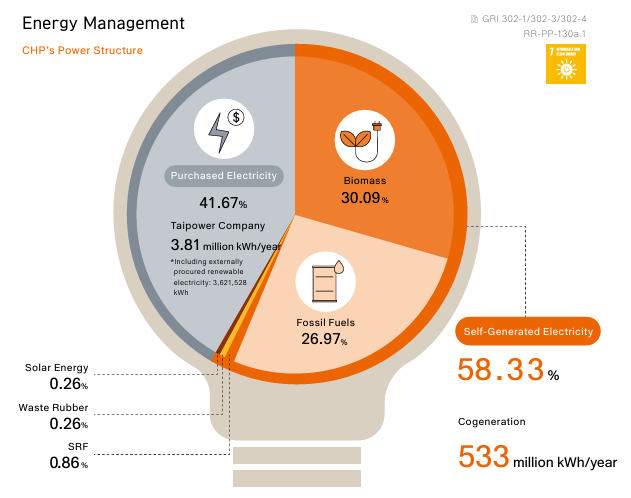
The co-generation system of steam and electricity makes full use of electrical and thermal energy to increase energy efficiency. Additionally, the application of a circulating fluidized bed technology would allow co-firing of regular fuel and bio-based waste materials. In short, the implementation of co-generation technology is part of our roadmap to achieve “zero waste and emission".In 2025, the total internal energy consumption of the organization was 16,908,821 GJ. Purchased electricity accounted for 1,371,239 GJ (comprising 9% grey elec tricity and 0.1% externally procured green electricity), while internally generated steam and electricity con sumption totaled 15,537,582 GJ, with biomass ac counting for 47.40% (8,015,552 GJ) and solar energy (as a percentage of other renewable energy sources) accounting for 0.24%.

Biomass energy
The biomass fuel called “black liquor” is generated from the conventional Kraft wood pulping process as a reusable waste material. The black liquor is sent to a recovery boiler for combustion to generate steam which is then sent to the co-generation system to generate steam and electricity. CHP actively promotes energy conservation and the expansion of green energy. In terms of internal self-generation and self-consumption in 2025, the proportion of biomass increased from 45.39% in the previous year to 47.40%, while the proportion of fossil fuels decreased from 43.07% to 42.48%, driven pri marily by the use of lignin as a substitute, alongside the utilization of SRF and recycled waste in alignment with government policies. Additionally, the proportion of solar energy increased from 0.09% to 0.24%, and newly procured green electricity at the Hualien Mill accounted for 0.08% of the total energy input this year. Regarding energy intensity, it was 19 GJ per unit of product (metric ton) this year, representing a 26% decrease compared to the base year.

Hydrogen energy
CHP's Hualien manufacturing plant is equipped with an electrolytic cell for the generation of bleaching agent and soda to be used in pulping process. It’s by-product, hydrogen, has a purity of up to 95% and can be directly burned for energy supply. With further purification to 99.99%, it can serve for applications such as the hydrogen fuel cell.

To address the issue of climate change, we shall set a higher standard for ourselves.
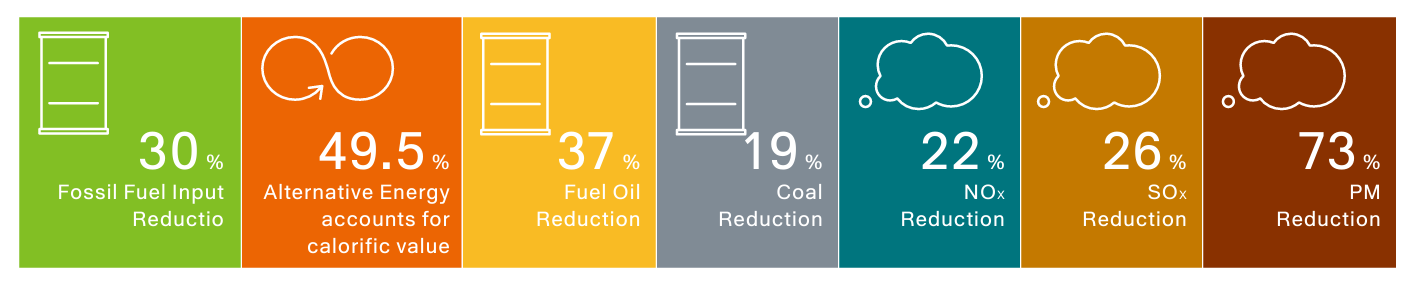
It is of great urgency to increase energy efficiency and reduce the use of fossil fuels. After continuous efforts, we have reduced coal use by 19% and fossil fuel use by 37% since 2022
We are committed to abide by the SDGs and continue to work hard to execute our work plan and evaluate the progress in the journey to achieve zero waste and zero emission.